


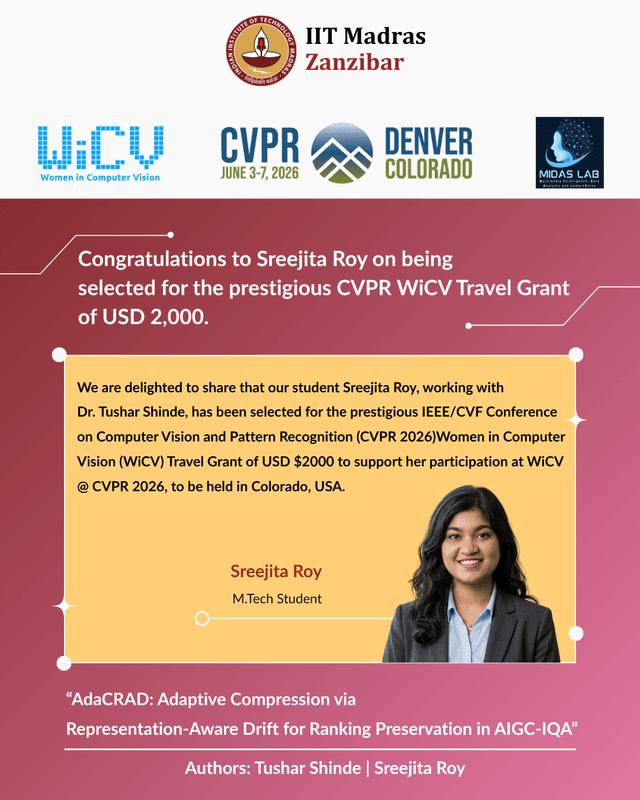
Women in Computer Vision (WiCV) Travel Grant of USD $2000
Student(s):Sreejita Roy (MTech Student)
Work:AdaCRAD: Adaptive Compression via Representation-Aware Drift for Ranking Preservation in AIGC-IQA
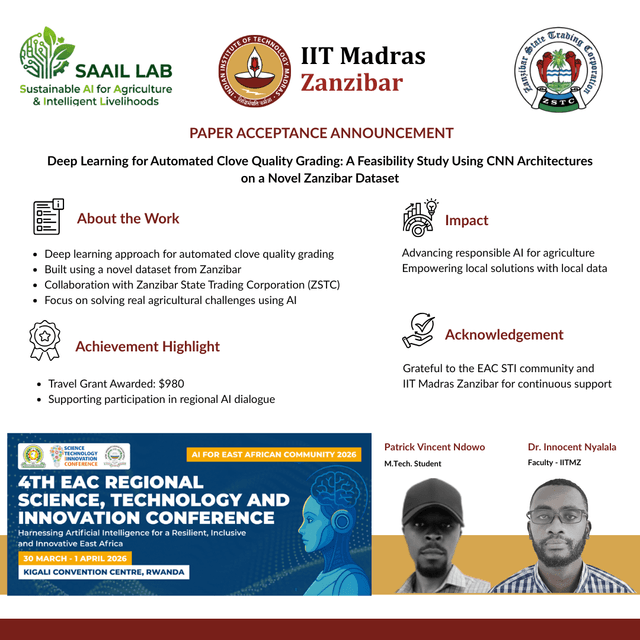
AI4EAC 2026 Travel grant of USD 980!
Student(s):Patrick Vincent (MTech Student)
Work:Deep Learning for Automated Clove Quality Grading: A Feasibility Study Using CNN Architectures on a Novel Zanzibar Dataset
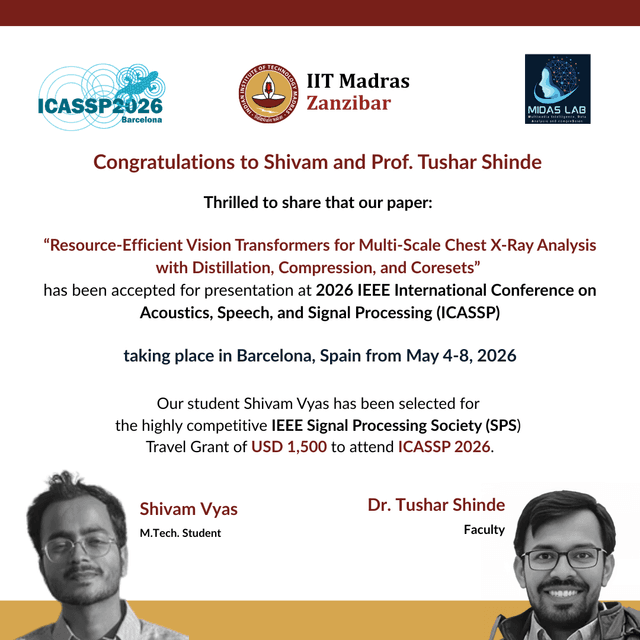
IEEE Signal Processing Society (SPS) Travel Grant of USD 1,500!
Student(s):Shivam Vyas (M.Tech student)
Work:Resource-Efficient Vision Transformers for Multi-Scale Chest X-Ray Analysis with Distillation, Compression, and Coresets

NeurIPS 2025 BrainBodyFM Travel Grant of USD $1500!
Student(s):
Work:Resource-Efficient ECG Foundation Networks via Layer-wise Adaptive Compression
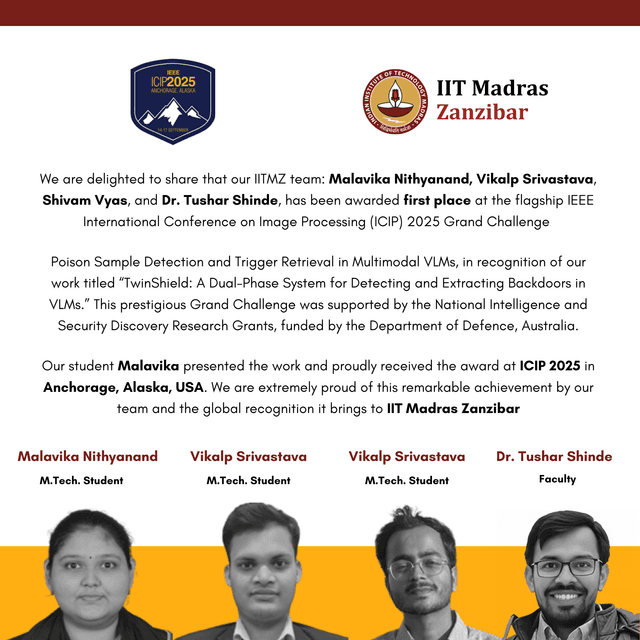
First Place - ICIP 2025 Grand Challenge
Student(s):Malavika Nithyanand (M.Tech student), Vikalp Srivastava (M.Tech student), Shivam Vyas (M.Tech student)
Work:TwinShield: A Dual-Phase System for Detecting and Extracting Backdoors in VLMs

NeurIPS 2025 GenAI in Finance Travel Grant of USD $800!
Student(s):Aisha Hamad Hassan (M.Tech student)
Work:eFinBERT: Efficient Financial Sentiment Classification
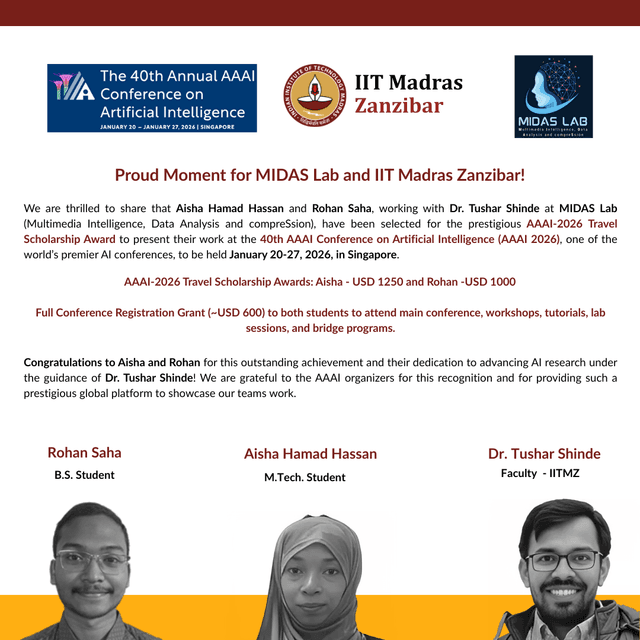
Aisha - USD 1250 (AAAI-2026 Travel Scholarship Award), Full Conference Registration Grant (~USD 600)
Student(s):Aisha Hamad Hassan (M.Tech student)
Work:Adaptive Coreset Selection via Uncertainty-Density for Efficient Spam Detection
Rohan - USD 1000 (AAAI-2026 Travel Scholarship Award), Full Conference Registration Grant (~USD 600)
Student(s):Rohan Saha (B.S. student)
Work:Bridging Machine Learning and Physics for Scalable Long-Term Building Temperature Prediction
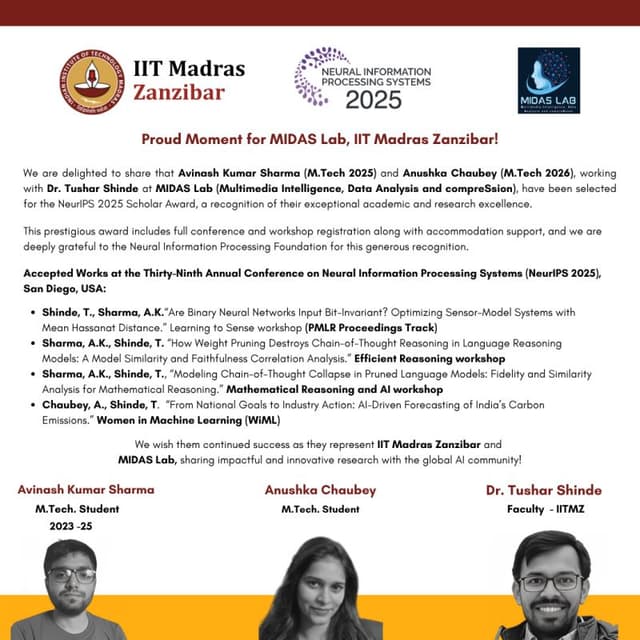
NeurIPS 2025 Scholar Award
Student(s):Avinash Kumar Sharma (M.Tech student)
Work:Are Binary Neural Networks Input Bit-Invariant? Optimizing Sensor-Model Systems with Mean Hassanat Distance, How Weight Pruning Destroys Chain-of-Thought Reasoning in Language Reasoning Models: A Model Similarity and Faithfulness Correlation Analysis, Modeling Chain-of-Thought Collapse in Pruned Language Models: Fidelity and Similarity Analysis for Mathematical Reasoning
NeurIPS 2025 Scholar Award
Student(s):Anushka Chaubey (M.Tech student)
Work:From National Goals to Industry Action: AI-Driven Forecasting of India’s Carbon Emissions
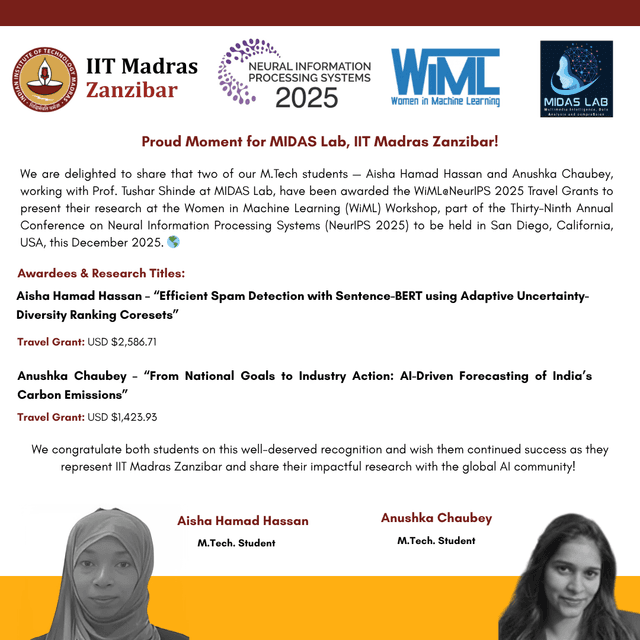
WiML@NeurIPS 2025 Travel Grant of USD $2,586.71
Student(s):Aisha Hamad Hassan (M.Tech Student)
Work:Efficient Spam Detection with Sentence-BERT using Adaptive Uncertainty-Diversity Ranking Coresets
WiML@NeurIPS 2025 Travel Grant of USD $1423.93
Student(s):Anushka Chaubey (M.Tech Student)
Work:From National Goals to Industry Action: AI-Driven Forecasting of India’s Carbon Emissions

ICCV 2025 Broadening Participation Travel Grant of $900 and $675 IEEE/CVF Student Registration Grant!
Student(s):Shivam Bhardwaj (M.Tech Student)
Work:Adaptive Compression of Large Vision Models for Efficient Image Quality Assessment of AI-Generated Content
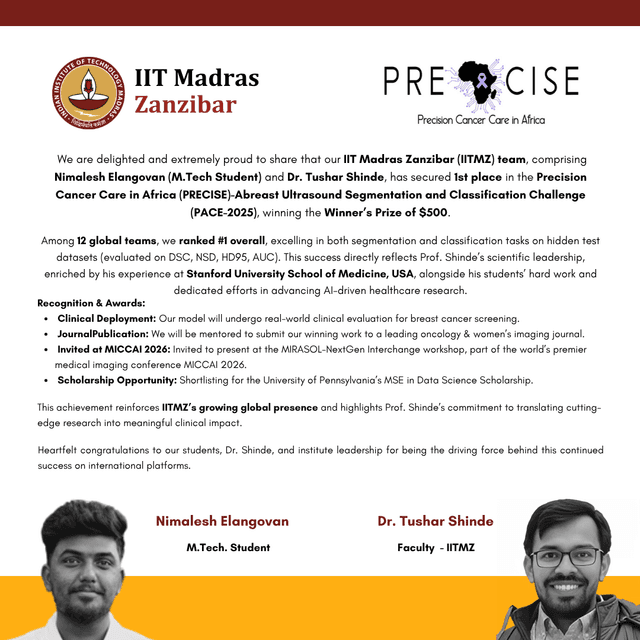
1st place - Winner's Prize of $500, Clinical Deployment, JournalPublication, Invited at MICCAI 2026, Scholarship Opportunity
Student(s):Nimalesh Elangovan (M.Tech Student)
Work:(PRECISE)-Abreast Ultrasound Segmentation and Classification Challenge (PACE-2025)
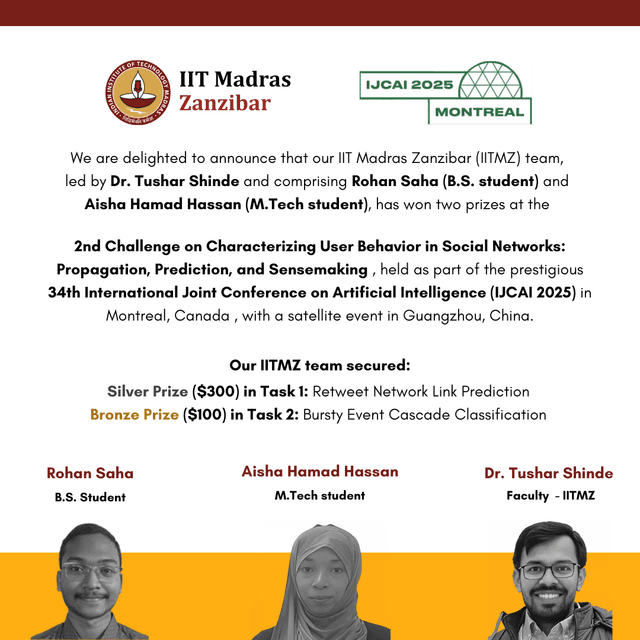
Silver in Retweet Network Link Prediction and Bronze in Bursty Event Cascade Classification
Student(s):Rohan Saha (B.S. student) and Aisha Hamad Hassan (M.Tech student)
Work:Silver in Retweet Network Link Prediction: This task focused on predicting the likelihood of future retweet links in large-scale social network graphs. Bronze in Bursty Event Cascade Classification: This task aimed to classify and detect bursty information cascades, i.e., sudden spikes of activity around emerging events in social networks.
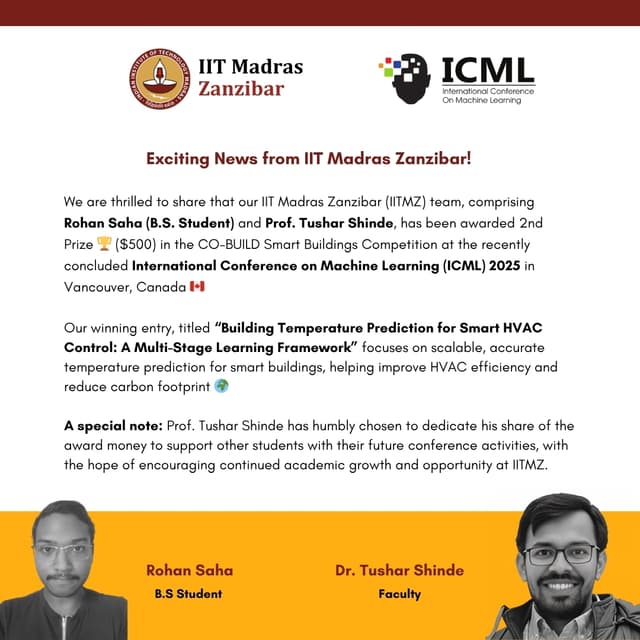
2nd Price - $500
Student(s):Rohan Saha
Work:Building Temperature Prediction for Smart HVAC Control: A Multi-Stage Learning Framework
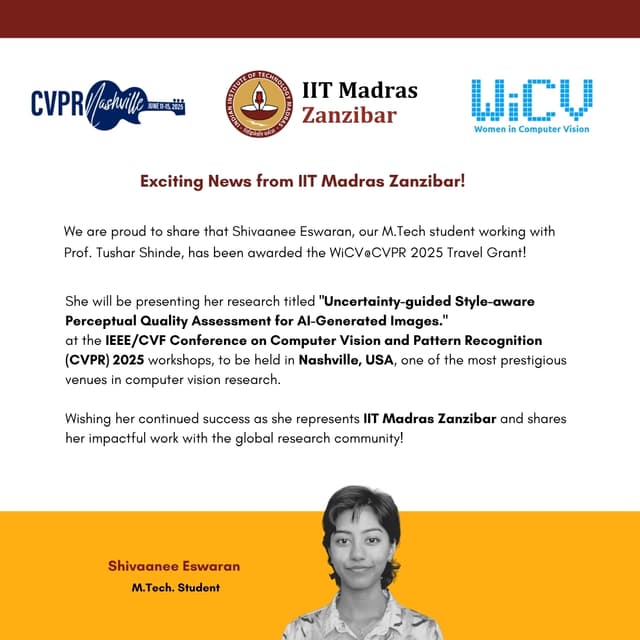
Women in Computer Vision Workshop (WiCV) at CVPR 2025 travel grant award
Student(s):Shivaanee Eswaran
Work:Uncertainty-guided Style-aware Perceptual Quality Assessment for AI-Generated Images
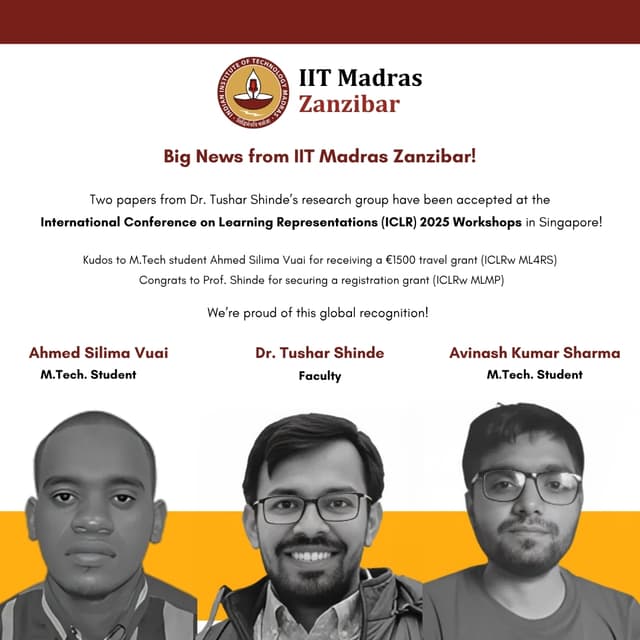
€1500 travel grant award
Student(s):Ahmed Silima Vuai
Work:Efficient Land-Cover Image Classification via Mixed Bit-Precision Quantization
Crossed French Mobility Program 2024
Student(s):Ahmed Silima Vuai and Shivam Bhardwaj
Work:Fully funded research stays for one semester at Grenoble INP, France, and Université de Nantes, Polytech Nantes, France
3rd place in VRD Intelligence and Understanding Leaderboard
Student(s):Vikalp, Shivam, Patrick, and Madhusudan
Work:VRD Layout Analysis and Structure Parsing competition